Why restraint reduction is important
By Kevin Ainsley
In his latest article, Kevin Ainsley DipSW, MSc (PBS) , shares his thoughts on why restraint reduction is important.
Notwithstanding that restrictive interventions are sometimes necessary to safeguard an individual; the inevitable impact of their use is a diminishment in the quality of life for the person being subjected to them. The degradation of quality-of-life is known to fuel increases in challenging behaviour. If staff respond to this increase by applying greater restrictions challenging behaviour increases in frequency, intensity, and duration. It is a very vicious cycle and there is nothing abnormal about it (except our traditional responses to it). Under circumstances where people are basically miserable and not having their needs properly met, the expression of frustration, sadness, anger, and distress are entirely normal and to be expected.
Restrictive interventions come in many forms, however physical restraint is particularly problematic. As well as the profound diminishment in quality of life it produces it also carries additional risks. These include injury to staff and pupils, damage to relationships, a breakdown in trust, the propensity for it to intensify behaviour we are trying to bring to a halt and of course even death (Gareth Myatt, see also Harper Courant data from USA).
Furthermore, the behaviour preceding restraint, the restraint itself, the restoration following restraint, subsequent administrative referrals, report writing, and potential injury also takes up lots of time that could be better spent teaching and learning.
For these reasons, our aim should be always to minimise their use. The least restrictive option should always be deployed and kept under regular review. When we consider schools in particular, those pupils being subject to positive handling, and especially those in Tier 3 (see diagram below), an individualised positive behaviour support plan (IPBSP) should be in place. Research indicates that the best IPBSP’s are based on a functional assessment of the pupil’s behaviour.
Reducing Restrictive Practices and School Wide Positive Behaviour Interventions and Supports (SWPBIS)
Traditionally, systems of responding to challenging behaviour within schools have been primarily reactive (waiting for things to go wrong) and overly reliant on punishment-based strategies to try and (re)shape behaviour. This does not seem to be working very efficiently in most instances. Yet this system tends to prevail in many education settings. (2)
Research suggests that around 85% of behavioural problems in schools are related to inherent problems with the systems being used. These problems can be ameliorated only through the actions of those who shape the system. This would include, head teachers, senior leadership team members, governors, policy makers, and of course teachers and teaching assistants. Put another way the fault is with the system, not with the students
As already mentioned, many ‘systems’ are rather reactive in their approach to behaviour and a ‘wait to fail’ education model inevitably leads to both behavioural dysfunction and academic underachievement.
SWPBIS counteracts this ‘wait to fail’ model of other frameworks and moves schools towards a model based on proactive preventative and proactive developmental strategies. This approach is designed to create an environment that enables effective teaching and high levels of learning.
SWPBIS is a Tiered Intervention Framework
SWPBIS meets the needs of all students through the construction of a continuum of supports for staff and students. There are three tiers to the continuum.
It provides all students with universal instruction, called Tier One (or Primary Prevention), using instructional and behavioural principles to teach a handful of schoolwide behavioural expectations (for example, be safe, be considerate, be responsible, be respectful). This foundational level serves a preventative purpose to mitigate challenging behaviour, and at least 80% of the students’ needs are met through universal instruction alone. (12)
A range of increasingly intensive evidence-based supports are available for students who need more direct support for behavioural concerns. About 10 to 15 % of students require supplemental targeted support called Tier 2 (or Secondary Prevention), and 3 to 5 % require intensive, highly individualised support called Tier 3 (or Tertiary Support). (13)
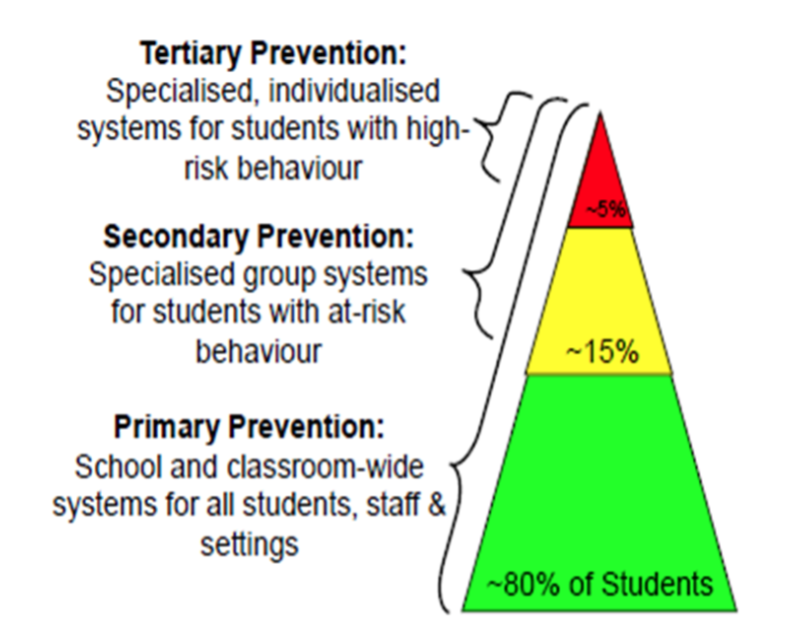
Organisations shifting from the traditional ‘wait to fail’ model to a SWPBIS approach see reductions in problem behaviours and a concomitant reduction in the use of restrictive practices including exclusions and physical restraint.
TIER 2 and TIER 3 Reducing Restrictive Practices: Individual Positive Behaviour Support Plans (IPBSP’s) and functional assessment.
IPBSP’s are a vehicle for helping to ensure student’s educational, behavioural, and quality of life needs are met. They are focused on proactive strategies. IBSP’s work by teaching the student new skills, behaviours and coping strategies and minimising known environmental triggers. There is an emphasis on improving the pupil’s social and emotional wellbeing through building trusting relationships with staff and creating opportunities for experiencing meaningful engaging activities that improve quality of life. As a result, the student’s needs are better met, behaviour improves, staff wellbeing also improves all of which obviates the need for the use of physical restraint. Research indicates that the most effective behaviour support plans are based on a functional assessment (FA) of the student’s behaviour.
A functional assessment enables us to understand the ‘purpose’ (function) of a particular behaviour. By purpose we mean what it is the person manages to access or avoid from behaving in a particular way. For example, a student might have learned that if they shout out during Q&A activities rather than raise their hand and wait patiently the teacher attends to them more quickly (the function of this behaviour would be attention). Or they may have learned that a good way to get excluded from a class they do not enjoy is to shout obscenities or throw things around (the function here is likely to be ‘demand avoidance’).
Identifying the purpose of a challenging behaviour enables us to be very precise and efficient in selecting appropriate proactive interventions. Basically, it enables staff to replace a wait-to-fail approach with a plan-to-succeed model.
Students supported with tier 2 and tier 3 interventions normally have some level of functional assessment informing their behaviour support plans.
Interventions for pupils in tier two are likely to be relatively time limited, involving the intensification of tier 1 strategies and implementing small group work sessions. The intention is to get them fairly quickly to a position were tier 1 strategies meet their needs entirely. For some pupils in this group having a basic understanding of the function(s) of their behaviour may enhance the interventions and accelerate the pupils’ progress. An adequate understanding of the function of behaviours for pupils in tier 2 can usually be established by looking at existing behaviour data and conversations with the pupils teaching staff.
For students in tier 3 an understanding of the function of their behaviour(s) is essential. The behaviours of pupils in this group are likely to be much more complex and detrimental to their learning, development, and overall quality of life. Interventions with pupils here will be highly individualised and likely to be in place for a much longer term than tier 2 (for some, subsisting beyond their time in education). For these pupils, a much more thorough functional assessment is likely to be required because best evidence suggest that individualised behaviour supports plans have far better outcomes when the strategies are based on known functions of behaviour
The Motivation Assessment Scale is an extremely useful and easy to use tool for assessing the function of a behaviour and adding value to the support plans for students receiving tier 2 and particularly tier 3 supports. We will be looking at this in a future article.
- The PBIS Tier 1 Handbook. Djabrayan & Hauser. Corwin 2015 (3) (6) (8)
- The PBS Tier 2 Handbook. Djabrayan & Hauser. Corwin 2018 (18)
- An Educators Guide to Schoolwide Positive Behavioural Interventions and Supports – Integrating all three tiers. J.E. Harlacher, BJ Rodriguez. Marzano Research 2018) (5) (13)
- Horner, R.H., Sugai, G., & Anderson, C.M. (2010) Examining the evidence base for school-wide positive behaviour support. Focus on Exceptional Children, 42(8), 1-14 (15), (16), (17).
- 6Luiselli, J.K., Putnam, R.P., Handler M.W., Feinberg A.B. (2005). Whole School Positive Behaviour Support: Effects on student discipline problems and academic performance. Educational Psychology, Vol.25, Nos. 2-3, April-June 2005, pp 183-198. (1)
- Skiba, R.J., & Rausch M.K. (2005). Zero tolerance, suspension, and expulsion: Questions of equity and effectiveness. In C. Everston & C.S. Weinstein (Eds.), Handbook of Behaviour
- Management: Research, practice, and contemporary issues (pp.1063-1089). Mahwah, NJ: Erlbaum. (9)
- PBS isn’t about Rewards or punishment, it’s about building relationships. Kate Strutt, Redstone 2017 (2) (7)
Published 16 April 2026
Share this story
More News
Back to news
Ready to Create Safer Environments?
Book a call with a member of our team today and discover how we can help
Book a Call