“Routines, Rituals and Wellbeing” – Why are they important?
By James Ridley
Think about the moment that you wake, you open your eyes and start your day? Then think about what you do, who you speak with or don’t, how long it might take you to “wake up”. Reflect on what are the important parts of your routine, is it your phone, your first brew (strong coffee, plenty milk, no sugar!), your shower routine, favourite “Smellies”, etc. NOW think about if the one thing that you have considered as important is not accessible or available to you? How would that impact or influence your day? Some will say that “I can manage”, or “It I can adapt”, but what if you can’t? or it influences your interactions with the day, with those around you, or even with your inner self? So, an additional question to reflect on do we take those actions, routines and rituals for granted, do those around us know what they are, do they know how important that they may be to us having a “good day”. But also, importantly do they know how to respond or enable us to re-establish or manage those changes in routines or rituals that are so important to us?
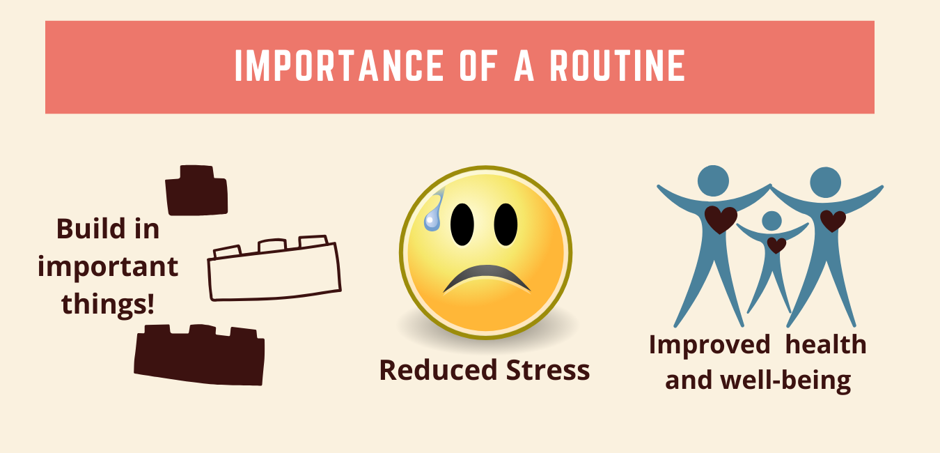
A simple image search related to the importance of routine and ritual brought this image and its simplicity also shows in my view its complexity, routine supports the “building of important things”, “reduces stress or distress”, and can “improve health and wellbeing”.
Simple? Not quite as all of these areas may require a number of approaches and thoughts that enable them to be true. For some the ritual or routine itself is an important thing, it may give structure, consistency and the knowledge of “what is next” this may seem to be a practical approach but that shouldn’t be dismissed as something without meaning, emotion, or purposeful thought. I would ask you to reflect on what are the “important things” that you have built into your routines or rituals, and if they weren’t available to you then how might that affect today, tomorrow or the day after because in reality if they aren’t there or available then it may not just impact on the “Today!”.
“Reducing stress” – well nobody wants to experience distress but that doesn’t mean that there aren’t going to be events that are stressful, one example of “modern life”…….my phone didn’t charge overnight!!!!! Well, that doesn’t seem stressful? Does it? But what if that device has a more powerful meaning to the individual, communication, connection, planning, identity, that may need to be considered when we think about the importance of not just the routine of access, but also the ritual of maintenance which in this case is “re-charging the batteries” no pun’s intended! If we position ourselves as wanting to know, understand and respond to stress then by having that knowledge we can look at how we adapt ourselves, or identify the “non-negotiables” that everyone needs to be aware of.
Health and wellbeing
A really important consideration and very much aligned to my professional background as a nurse where my role has been about supporting health and wellbeing. BUT health and wellbeing is a very wide concept and will mean many differing things to individuals.
As such if having access to rituals and routines supports health and wellbeing then it also needs to recognise how these likely come together, how they support each other, and how if one is disrupted or changed then the impact it may have on my overall and long-term health and wellbeing. My rituals and routines may not impact on today, but a disrupted routine or ritual may influence and impact on tomorrow’s health and wellbeing and so on, as such I might need to be supported around adaptation, around establishing new routines, or helping me to “keep” that which is important to me.
As always, I want to reflect on this in the context of our core principles at PRICE Training, and I want to focus on our core principles related to “Having an understanding and awareness of the needs of those being supported” and “Plan and prioritise for the use of primary, secondary and non-restrictive”. If we are thinking about supporting people, and I mean “Everyone!” then we need to be in a position where we commit to understanding a person, their rituals and their routines, not only because they are important to them but may also be important for them! In that scenario I would want people around me who can help me manage my day, support and enable me to meet my needs, and in doing so enable me to maintain the important things in my life, reduce any levels of stress or distress, and support me in maximising my health and wellbeing. So next time we think about how we support someone at any stage of their day, let’s be mindful of what “their” day looks like, what “their” routines and rituals mean to them and how we support the individual. Commitment to this is a fundamental part of what we do and why we do it, so we continue that commitment to “Protecting Rights In Care Environments”.
Published August 2026
Share this story
More News
Back to news
Ready to Create Safer Environments?
Book a call with a member of our team today and discover how we can help
Book a Call